
Balance games use seesaw activities to introduce fundamental physics concepts to young children. By comparing weights and predicting movement, children develop essential cognitive skills while exploring scientific principles. These activities support early STEM learning and critical thinking development in an engaging, age-appropriate format.
Benefits for Child Development
Balance games significantly contribute to:
- Spatial reasoning: Understanding how objects relate in space
- Comparative analysis: Learning to compare and contrast different items
- Predictive thinking: Anticipating outcomes based on observations
- Mathematical foundations: Preparing for future concepts like equations and ratios
- Scientific method: Observing, hypothesizing, and testing predictions
Worksheet Downloads by Level
Below are download links for all five progressive levels of balance game worksheets. Each level is designed to build upon previous concepts while introducing new challenges appropriate for developing minds. Detailed explanations and implementation strategies for each level are provided in the following sections.
Progressive Learning Structure
The worksheets are organized in five levels, beginning at age 3. Each level builds upon previous concepts, allowing children to progress at their own pace. Levels 4 and 5 are optional advanced challenges that can be introduced when children show readiness.
Level 1: Basic Weight Comparison
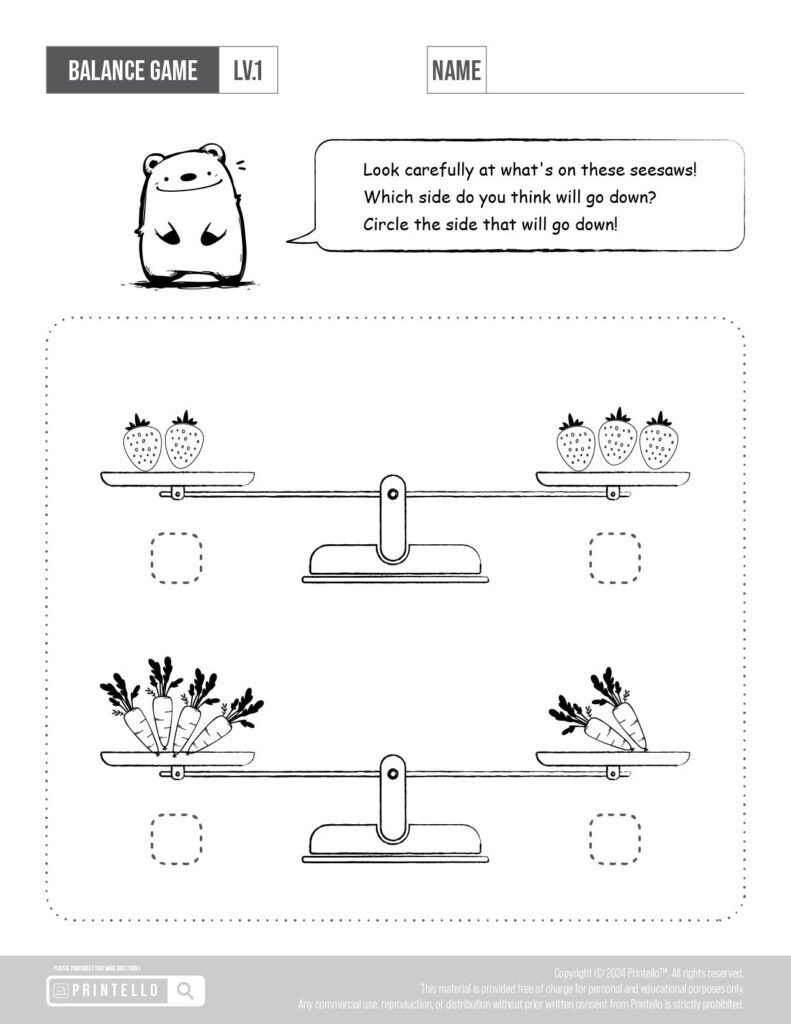
Children observe pictures on seesaws and identify which side will move down or up. This foundational level helps develop
- Visual discrimination skills
- Understanding of cause and effect
- Vocabulary development (“heavy,” “light,” “up,” “down”)
- Following directional instructions
Implementation tip: Ensure children understand whether questions ask about upward or downward movement, supporting both physics learning and reading comprehension.
Level 2: Ordinal Weight Relationships
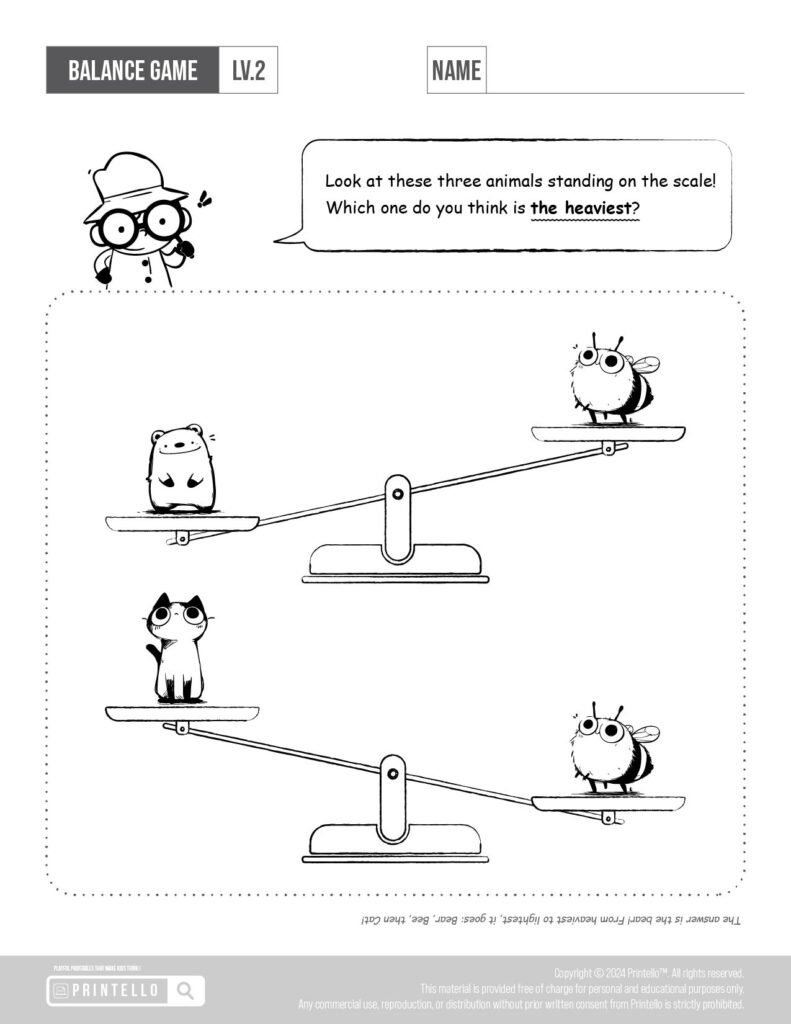
This level introduces three objects across two seesaws. Children determine weight order by finding common reference points. Skills developed include:
- Transitive reasoning (if A>B and B>C, then A>C)
- Ordinal number concepts (“first,” “second,” “third”)
- Systematic comparison strategies
- Working memory enhancement
Teaching suggestion: Using manipulatives like blocks or toys helps children visualize abstract relationships concretely.
Level 3: Applied Weight Predictions
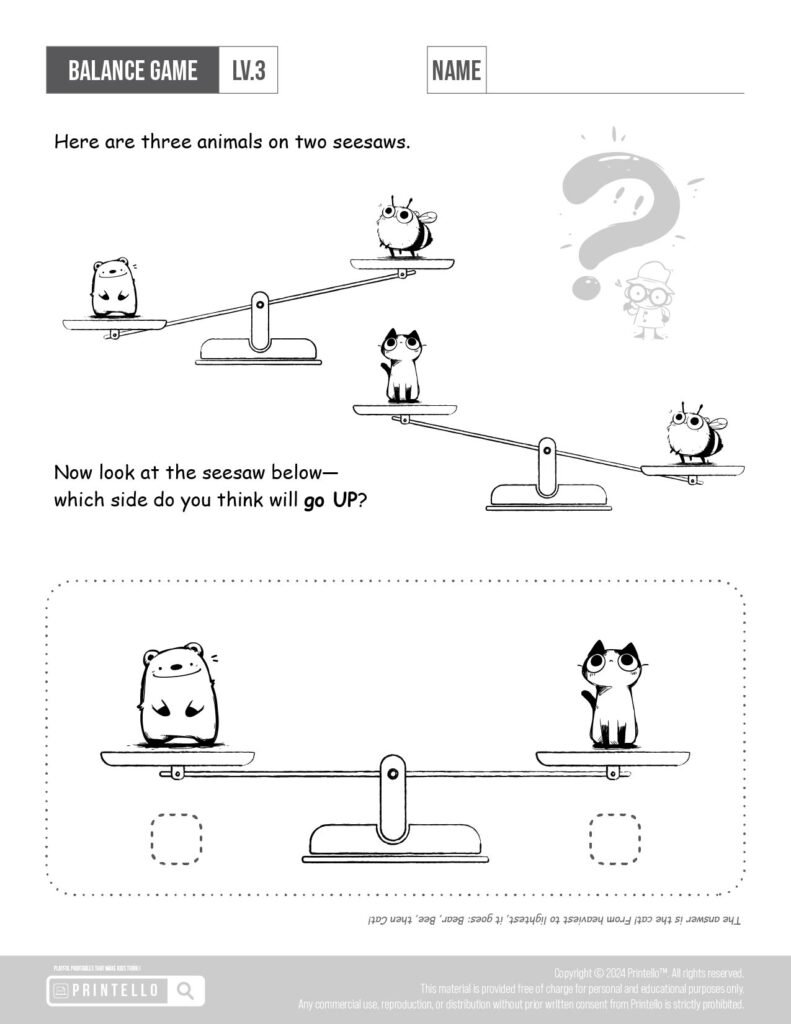
Children apply knowledge from two seesaws to predict outcomes on a third configuration. This level strengthens:
- Logical deduction skills
- Mental manipulation of information
- Application of learned principles
- Problem-solving flexibility
Level 4: Complex Multi-Object Scenarios
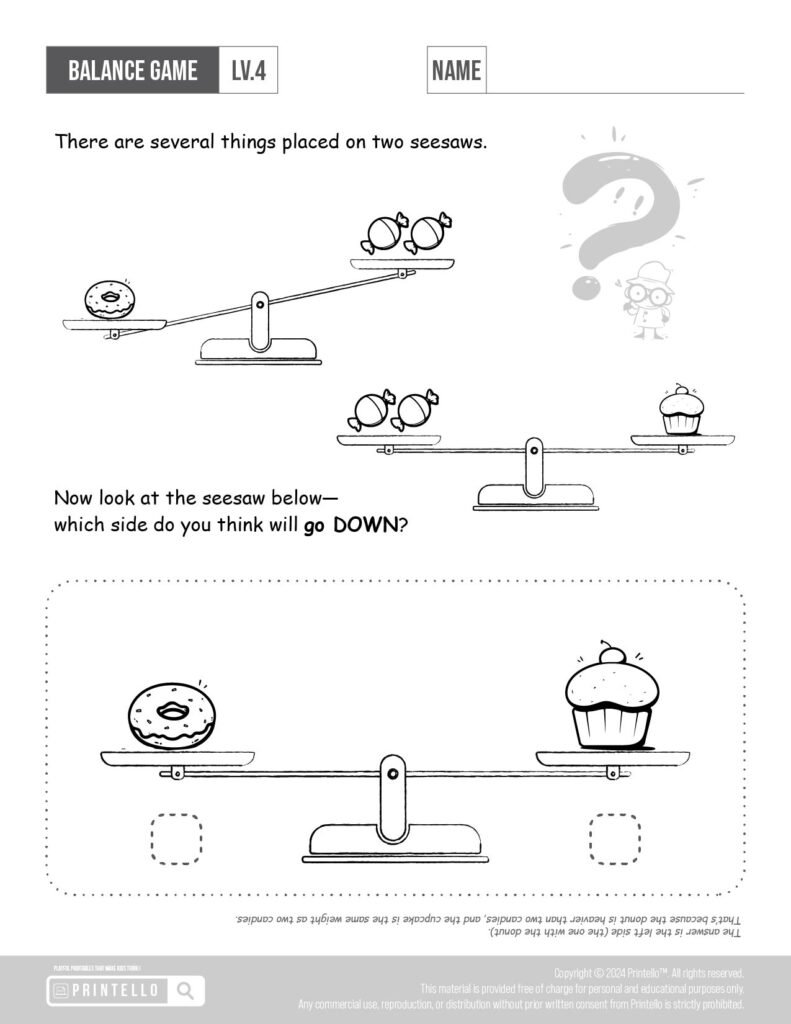
Multiple quantities of objects introduce algebraic thinking. Benefits include:
- Understanding that quantity affects total weight
- Early multiplication concepts
- Complex problem-solving strategies
- Abstract thinking development
Note: Physical balance scales greatly enhance understanding at this level through hands-on experimentation.
Level 5: Active Balance Creation
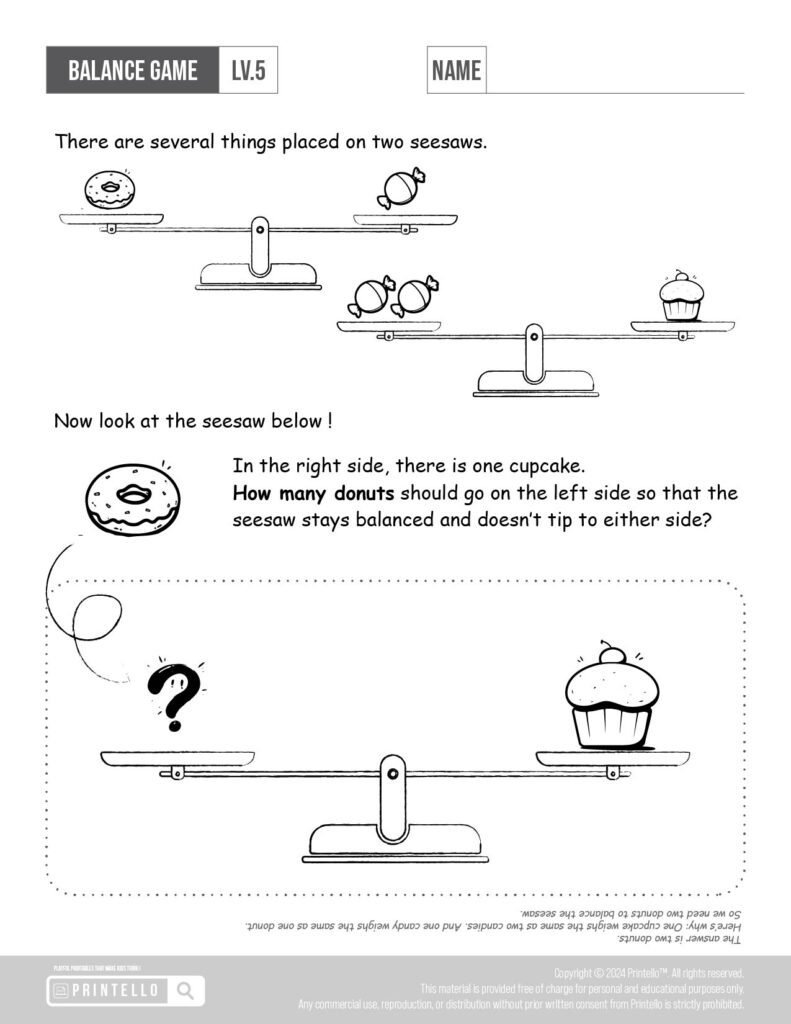
Children determine what’s needed to create equilibrium. This highest level promotes:
- Hypothesis formation and testing
- Trial-and-error learning
- Creative problem-solving
- Mathematical reasoning
- Executive function skills
Implementation Guidelines
- Before starting: Demonstrate concepts with real objects when possible. Concrete experiences help children connect abstract drawings to real-world physics.
- Pacing: Allow children to master each level thoroughly before advancing. Some may spend weeks on Level 1, while others progress quickly. Both approaches support healthy development.
- Error handling: When children make mistakes, explore their reasoning. This process often reveals sophisticated thinking and provides teaching opportunities.
- Answer keys: Each PDF includes answers at the bottom. Please report any errors for prompt corrections.
Educational Value
These balance games align with early childhood development principles by:
- Providing concrete representations of abstract concepts
- Allowing self-paced progression
- Encouraging active learning through prediction and verification
- Supporting multiple learning styles
- Building confidence through achievable challenges
Conclusion
Balance games offer rich opportunities for developing scientific thinking, mathematical reasoning, and problem-solving skills. Through playful exploration of weight and balance, children build cognitive foundations that support future academic success while enjoying the discovery process.
For those interested in exploring additional learning areas, please visit our comprehensive worksheet library, which includes Memory Games, Language Play, Logic & Puzzle Activities, Math Fun, and Observation Skills. Each category is designed to support specific developmental milestones while maintaining the same commitment to quality and age-appropriate progression.
Thank you for supporting children’s growth through thoughtful educational activities.